
DE | EN
CASE STUDY
Customized mobile dealcoholization, implemented for the first time with a regional brewery.
How the Winkler brewery, together with ATEC GmbH, implemented a solution for medium-sized breweries to produce non-alcoholic beers with a distinctive character.
The Winkler brewery in Amberg therefore consciously opted for a product-friendly dealcoholization process using reverse osmosis. Together with ATEC GmbH from Giengen an der Brenz, a mobile and flexible concept was developed that takes into account both the technological and sensory requirements of the medium-sized enterprise.
The market for non-alcoholic beers is evolving dynamically. At the same time, demands regarding product quality and sensory authenticity are constantly rising. Mid-sized breweries, in particular, face the challenge of developing non-alcoholic varieties that blend seamlessly into their existing portfolios in terms of taste. Purely technical dealcoholization is no longer sufficient; factors such as aroma profile, flavor stability, and the preservation of the brewery’s signature character are crucial. Parallel to this, there is a growing trend toward non-alcoholic beers that aim to replicate the taste of established alcoholic varieties as closely as possible.
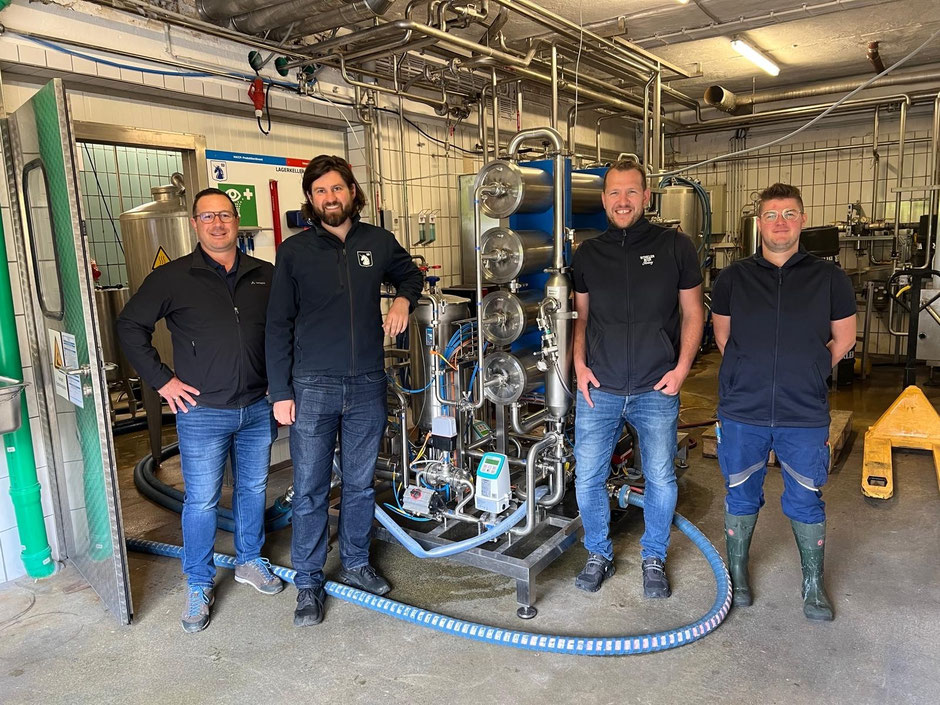
Left to right.: Martin Wörner (ATEC GmbH), Maximilian Winkler (Bräu), Lukas Götz (1. Brewmaster), Jonas Huber (2. Brewmaster)
The non-alcoholic beer needed to reflect the signature style of the Winkler brewery
Maximilian Winkler quickly realized that his own brewery was too small to utilize such a system in a cost-effective manner. At the same time, the company did not want to outsource production to a third party but rather produce the non-alcoholic beer in-house. Assuming that many other family-run breweries face a similar situation, a mobile dealcoholization system was developed; this enables even smaller craft breweries to access state-of-the-art, independent dealcoholization technology.
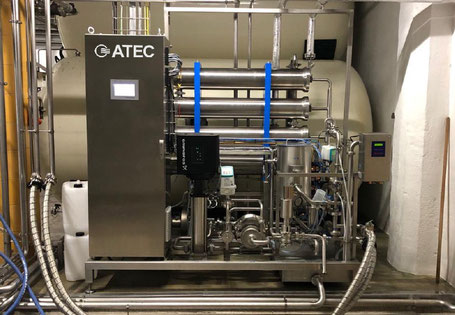
This innovation allows other breweries to brew their own beer and subsequently dealcoholize it. Consequently, the planning and implementation phases demanded high standards to ensure that all necessary system components could be installed compactly and portably on a sturdy frame. Now, all that is required is to connect the beer tank and the deaerated water, and then start the process.
Why dealcoholization via reverse osmosis?
The non-alcoholic beer was not intended to stand apart from the existing product range as a separate "specialty product," but rather to consistently maintain the brewery's sensory identity. In particular, key flavor components, full-bodied character, and the familiar aroma profile were to be preserved.

“We deliberately opted for a non-alcoholic solution using membrane dealcoholization, as it best reflects the characteristic flavor profile of the Winkler brewery.”
BREWERY OWNER Maximilian Winkler
In addition to stringent sensory requirements and the need for equipment mobility, a flexible recipe structure played a pivotal role. The aim was to find a solution that could adapt flexibly to varying production volumes while ensuring simple, practical operation.
Focus on product-friendly membrane technology
The project centered on the decision to use a membrane-based dealcoholization method. The goal was to minimize thermal stress on the beer, thereby preserving delicate aroma components and the familiar, well-balanced full-bodied character.
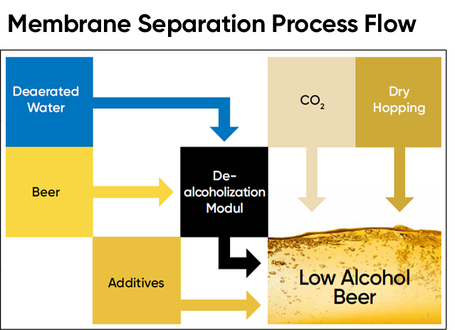

Membrane technology offers distinct advantages regarding flavor stability and sensory authenticity, particularly for beers with a strong flavor profile. When selecting the membranes, the focus was specifically on achieving high retention rates (>99%) to ensure that all aromatic and flavor characteristics remained in the beer—a key factor distinguishing reverse osmosis from nanofiltration. Deaerated water is currently supplied using a manual stripping process. This enabled the brewery to enter the non-alcoholic production segment quickly and flexibly while simultaneously gaining practical operational experience.
A collaborative partnership based on mutual respect
For the Winkler brewery, the collaboration with a partner geared towards the SME sector was just as crucial as the technology itself.
“We chose ATEC to pursue our path as a medium-sized brewery alongside a growing company. We always felt well-supported and understood throughout the process.”
Brewery Owner Maximilian Winkler
Individual, practical solutions were a priority throughout the project planning, implementation, and commissioning phases. ATEC provided support for all process-related decisions—from the selection of raw materials and the brewing process itself through to final storage.
Initial experience was gained using a pilot plant. Notably, this system was designed to be identical to the main plant in terms of functionality and programming sequences. This allowed the master brewer and operators to gain hands-on experience with the workflow on-site and to collaboratively ensure the integrity of both the recipe structure and process integration.
Developing suitable brewing recipes proved to be particularly challenging over the course of the project. Alcohol-free beers are sensitive to changes in the brewing process, requiring precise coordination between the recipe and process parameters. A concept must be developed on an individual basis, tailored to the specific brewery, since every brewery operates differently.
“We faced several hurdles along the way, including during the initial trials with the test system. Delivery times and the creation of custom brewing recipes presented us with challenges. Ultimately, however, we found a partner who always provided answers to our questions and offered practical solutions.”
Brewery Owner Maximilian Winkler
Rapid Market Launch and Partnership Secured
Following an extended trial phase and the system’s eventual commissioning in March 2026, the brewery successfully launched the new non-alcoholic beer on the market. It also secured its first peer-level partner: Schlossbrauerei Fuchsberg.
A particularly crucial aspect was the need to carefully evaluate the sensory profiles of both breweries separately. The objective was to ensure that the respective non-alcoholic *Helles* (pale lager) fit seamlessly into each brewery's product portfolio. "The differences in the brewing process could not be greater—starting right from the boiling systems used by the respective breweries," notes Martin Wörner (Brewmaster and ATEC Project Manager).

From the perspective of both breweries, it was possible to create a mobile yet independent expansion—individually and credibly—without diluting the existing brand identity. Unlike externally produced contract brews, full control over the recipe, processing, and product characteristics remained in-house.
“We were able to launch a non-alcoholic beer on the market that perfectly reflects the brewery’s signature style.”
1. BrewMaster Lukas Götz; Winkler Brewery
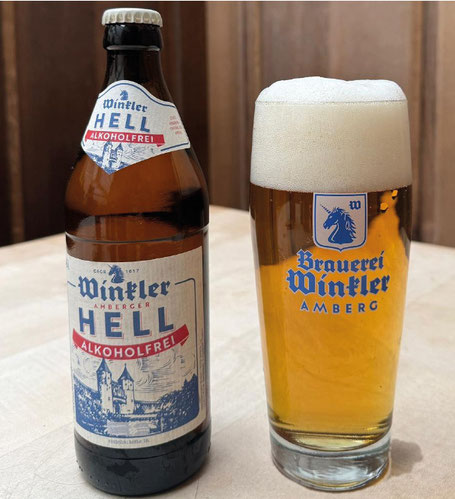
World’s first facility of its kind
A unique aspect of the project is the shared use of the facility. The unit can be transported to the respective brewery by van or truck. "The challenges here lay in accommodating the dimensions, ensuring process reliability, and complying with local regulations," says Florian Unseld (Managing Director, ATEC).
Organized by the Winkler Brewery, the dealcoholization unit is rented out, and the necessary equipment is provided. In preparation, the recipes at both facilities were fine-tuned to suit their respective brewing, fermentation, and maturation processes.
This allows each partner brewery to produce its own beers independently and dealcoholize them according to its own specific sensory targets. The project serves as a prime example of how cooperative plant concepts can make investing in modern dealcoholization technology economically attractive, even for medium-sized enterprises.
Energy and resource efficiency remain key priorities
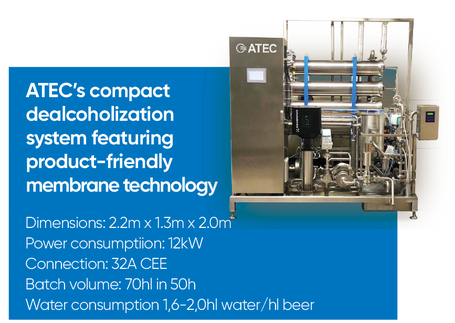
While membrane-based processes offer sensory advantages, water and energy consumption remain important topics of discussion within the industry. The reverse osmosis system was designed to
dealcoholize 70 hectoliters of beer in 50 hours. Thanks to the careful selection of membranes, the system achieved high retention rates and water consumption of less than 1.8 hectoliters per
hectoliter of beer.
"At first glance, the water and energy consumption figures might seem surprising, but they are dictated by the laws of physics. We also had to consider the quality of the wastewater in relation
to our on-site treatment plant," says Franz Vogl, Managing Director of Schlossbrauerei Fuchsberg. Energy-efficient plant concepts and intelligent process integration are becoming increasingly
important, especially given the rising demands for sustainable production processes.
Medium-sized breweries need flexible solutions
Experience from the project shows that medium-sized breweries, in particular, require solutions that are individually tailored and flexible. ATEC GmbH is not alone in this market. MMS AG was brought on board as a membrane technology partner as early as 2018. Backed by decades of experience, membrane expertise and brewing know-how can be combined effectively and purposefully.
ATEC GmbH therefore focuses on customized solutions developed in collaboration with MMS AG, Zurich. These solutions address both the technical and economic requirements of small and medium-sized enterprises.
“The ATEC team understands and implements the specific needs of medium-sized breweries and provides practical expertise—including in areas where additional technical process components are required.“
Brewery Owner Maximilian Winkler
Non-alcoholic beers with a distinct identity
For many breweries, non-alcoholic beer will in future be far more than just an addition to their product range. It will be crucial to maintain a distinct sensory identity within the non-alcoholic segment as well. The Winkler brewery views this as one of the industry's key challenges for the future.
“Summoning the courage to create non-alcoholic beers with a distinctive signature of their own—while seamlessly building upon the structure of the existing varieties—will remain one of the key challenges.”
Brewmaster and ATEC Project Manager Martin Wörner
Experience from this project demonstrates that gentle membrane processes can make a significant contribution in this regard. A project is particularly successful when brewery philosophy, existing conditions, process understanding, and sensory standards are consistently aligned!
